
Site survey and distributed antenna engineering for code-compliant, stable indoor cellular coverage.
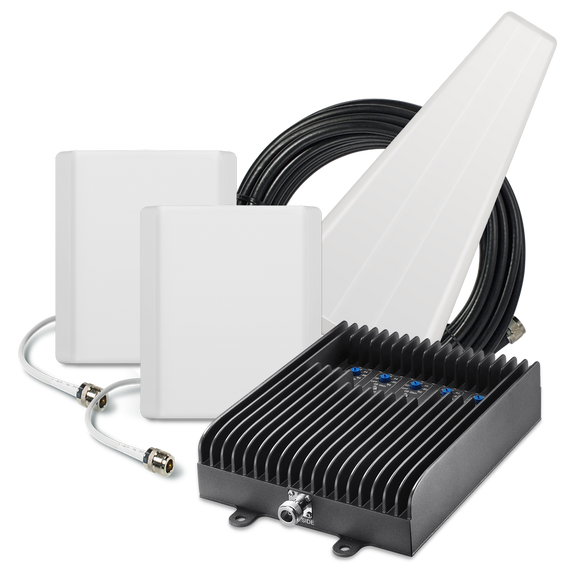
Product and design guidance
SureCall system design maps carrier/band signals, building losses and user areas, then selects donor antennas, coax/fiber distribution and indoor antennas. Poor isolation can cause oscillation or reduced gain. Confirm current FCC certification, registration/carrier consent, grounding and lightning protection.
- Carrier/band survey and coverage heat map
- Donor antenna sector choice and isolation analysis
- Indoor antenna count, cable/fiber losses and zoning
- Commissioning, FCC/carrier requirements and post-install testing
- Site survey, applicable codes and approved operating sequence
- Power, network/radio, standby and outage behavior
- Current product lifecycle, firmware and integration compatibility
- Training, documentation, inspection and preventive maintenance
Engineering and privacy
Boston High Tech confirms the current manufacturer model and site conditions before procurement. Relevant qualifications can be verified privately when appropriate; certificate copies, license numbers and named certificate-holder records are not published.
Request a site-specific design
Supported from our Charlotte headquarters and local client offices serving Massachusetts, New York and New Jersey. Arrange office visits in advance.
Official manufacturer references
How to compare and specify this product family
For SureCall RF Survey, Antennas and Enterprise DAS Planning, the right model and architecture depend on the site, existing infrastructure and operating policy. A proposal should clearly document the following signal-booster or distributed-antenna system decisions before equipment is ordered:
- Carrier and frequency-band requirements
- Outdoor donor-signal readings and building loss
- Donor/server antenna separation and isolation
- Coax routes, connector loss and grounding
- Coverage targets for each occupied area
- Monitoring, labeling and future carrier changes
Installation, testing and handoff
We begin with an RF survey rather than selecting an amplifier from square footage alone. The design documents measured signal, serving bands, antenna locations, cable loss, isolation and the coverage target for each priority area. Installation includes grounding and bonding review, labeled cable paths, commissioning measurements and a handoff record. Equipment must be used within current manufacturer and regulatory requirements; a booster cannot create usable service where adequate donor signal is unavailable.
Frequently asked questions
Questions about surveying cellular coverage, placing donor and indoor antennas, and meeting the rules that apply to boosters.
How is the number of indoor antennas decided?
From the survey, not from square footage. A carrier/band survey and coverage heat map shows where signal is already usable and where building loss kills it, and indoor antenna count, cable/fiber losses and zoning follow from that map. Stairwells, elevator shafts and below-grade areas are each handled as their own zone rather than absorbed into an open-floor number.
What decides where the donor antenna points?
Outdoor donor-signal readings taken at the roof, carrier by carrier and band by band. Donor antenna sector choice and isolation analysis then settle the mount: the sector with the cleanest usable signal for the carriers in scope, positioned where it stays separated from the indoor antennas. A stronger reading in the wrong sector is not the better mount.
Why does separation between donor and indoor antennas matter so much?
Because poor isolation can cause oscillation or reduced gain, and a system running in either condition will not deliver the coverage it was engineered for. Vertical separation, roof structures and the pattern of each antenna all feed the donor antenna sector choice and isolation analysis, and that analysis is settled before mounts are set rather than after the coax has been dressed in.
How much does the cable run affect performance?
Enough to change the design. Coax routes, connector loss and grounding are part of the loss budget, since every connector and every foot of run subtracts from what reaches the antenna, which is why long paths sometimes move to fiber distribution. Grounding and lightning protection at the donor entry are part of the install scope and are inspected at commissioning.
Do we need anyone’s permission before turning a booster on?
Yes. Registration and carrier consent apply to these systems, and current FCC certification of the specific model is verified rather than assumed from an older datasheet. Commissioning, FCC/carrier requirements and post-install testing are scheduled as one block of work, so approvals are named in the proposal instead of surfacing on turn-up day.
Will every carrier our staff use be covered?
Only the carriers and bands the design includes, which is why carrier and frequency-band requirements are settled at the start. A survey that reads one carrier well and another poorly leads to different donor decisions, and a band nobody surveyed will not appear later. List the carriers your staff and visitors rely on, including any that matter only in specific areas.
Official SureCall software, firmware and support
Official manufacturer resources. We link out rather than host firmware.
Before updating: confirm model, hardware revision, current version, entitlement and rollback plan, and schedule monitored or life-safety-adjacent systems with the administrator.