
Cloud-managed visitor, resident, gate and door access integrated with LiftMaster operator systems.
Product and design guidance
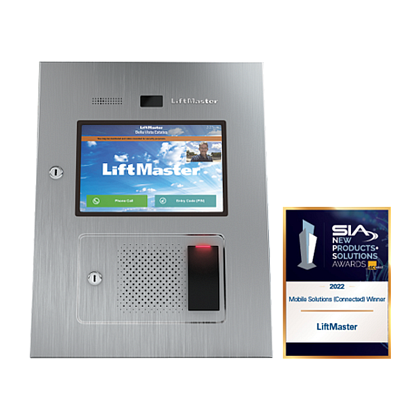
myQ Community/Business can combine CAPXL/CAPXLV video intercoms and CAP2D door controllers across multiple entrances. Define subscription, resident onboarding, visitor passes, call routing, cellular/Wi-Fi/Ethernet connectivity, local offline access and elevator/gate integration.
- CAPXLV video intercom screen/camera and call workflow
- CAP2D door controller and Wiegand reader interfaces
- myQ Community/Business roles, schedules and guest management
- Wireless gate links, cellular modem, local database and outage behavior
- Site survey, applicable codes and approved operating sequence
- Power, network/radio, standby and outage behavior
- Current product lifecycle, firmware and integration compatibility
- Training, documentation, inspection and preventive maintenance
Engineering and privacy
Boston High Tech confirms the current manufacturer model and site conditions before procurement. Relevant qualifications can be verified privately when appropriate; certificate copies, license numbers and named certificate-holder records are not published.
Request a site-specific design
Supported from our Charlotte headquarters and local client offices serving Massachusetts, New York and New Jersey. Arrange office visits in advance.
Official manufacturer references
How to compare and specify this product family
For LiftMaster myQ, CAPXLV, CAP2D and Community Access, the right model and architecture depend on the site, existing infrastructure and operating policy. A proposal should clearly document the following access-control system decisions before equipment is ordered:
- Number and type of controlled openings
- Controller, reader, lock and credential compatibility
- Cloud or on-premise administration and ownership
- Offline behavior, backup power and emergency operation
- Directory, HR, video, visitor and elevator integrations
- Licensing, cybersecurity, training and lifecycle support
Installation, testing and handoff
A site survey records each opening, door hardware, cable path, power, network, credential policy and integration requirement. The design then maps readers, controllers, locks, inputs, outputs and administrator roles to the operational workflow. Commissioning includes door-by-door functional tests, failure-mode and backup-power checks, permission and schedule tests, event verification, administrator training and as-built documentation. Product availability, subscriptions and supported integrations are confirmed for the current project before procurement.
Frequently asked questions
Questions about running resident, visitor, door and gate access across several entrances on one cloud-managed platform.
We were quoted a CAPXLV and a CAP2D. What does each one do?
They cover different halves of an entrance. CAPXLV is a video intercom with a screen and camera that carries the call workflow to a resident or an office; CAP2D is a door controller that provides Wiegand reader interfaces at the opening. An entrance where visitors announce themselves needs both, while a badge-only back door may need only the controller.
Is Ethernet required at the gate house?
Not necessarily. Cellular, Wi-Fi and Ethernet are the connectivity paths available, and the survey picks one per entrance based on what already reaches that location. Wireless gate links and a cellular modem cover entrances where no cable exists. Signal is measured on site, because a path that works at the lobby is not proof at the perimeter.
Do the readers already mounted at our doors have to be replaced?
Not where they output Wiegand. The CAP2D door controller and Wiegand reader interfaces are what an existing reader lands on, so check each reader’s output format and its wiring back to the closet before counting on reuse. A reader that stays also keeps its credential technology, which deserves a separate look if a credential change was on your list.
How do residents get set up, and how do their guests get in?
Through the roles, schedules and guest management defined in myQ Community/Business. Resident onboarding and visitor passes are configured as part of the deployment, so decide who enters residents, how a resident invites a guest and how long a pass stays valid. Settle that operating policy before the first entrance goes live, because it drives call routing as well.
Can the same platform cover the vehicle gate, the lobby door and the elevator?
Across multiple entrances, yes, and elevator/gate integration is one of the items defined during design rather than assumed afterward. The scope should name each entrance, the hardware serving it and how it connects. Confirm the specific elevator and gate equipment on site, since the interface depends on what is already installed there.
What happens at an entrance if the internet goes down?
It depends on the path that entrance uses and on what you specified for it. Local offline access, the local database and outage behavior are defined per entrance during design, so record the answer entrance by entrance. A gate on a wireless link and a lobby door on building Ethernet do not share a connection, and their answers can differ.
Official LiftMaster software, firmware and support
Official manufacturer resources. We link out rather than host firmware.
Before updating: confirm model, hardware revision, current version, entitlement and rollback plan, and schedule monitored or life-safety-adjacent systems with the administrator.