
A cloud smart-access platform designed for apartment units, common areas and perimeter entrances in multifamily properties.
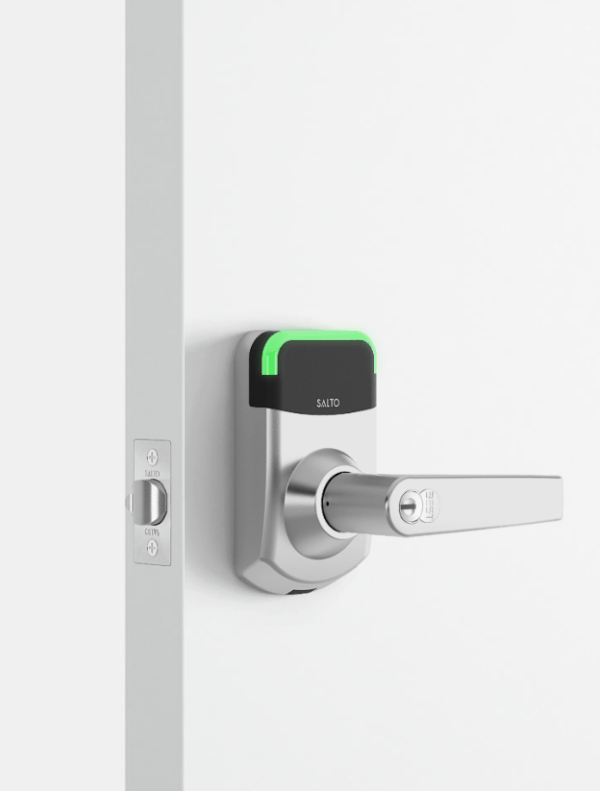
What this product family does
SALTO describes Homelok as an all-in-one residential solution with web/mobile management, smartphone and smart-card access and hardware spanning apartment doors, common spaces and perimeter access. Its open/API-ready approach can support property-management integrations, but exact partner and workflow compatibility must be verified.
Products and decisions
| Product area | What it includes | Selection guidance |
|---|---|---|
| Apartment doors | Compatible smart lock and retrofit hardware including current Homelok families | Survey preparation, handing, fire label, privacy function and resident battery access |
| Common/perimeter | XS4 locks, cylinders, readers and BLUEnet controllers as applicable | Choose online vs. virtual/offline behavior by opening risk and traffic |
| Residents and staff | Mobile app and smart card access | Map move-in/out, guests, staff masters, lockouts and phone replacement |
| Property systems | API/partner ecosystem | Define source-of-truth data, sync timing, audit and exception handling |
Questions to answer before quoting
- Unit count, common areas and perimeter openings
- PMS integration and resident onboarding
- Mechanical-key override and emergency access
- Battery service and turnover procedures
- Who owns administration, backups, updates and recurring services?
- What must continue working during network, internet or power failure?
- Which opening, egress, accessibility and life-safety requirements apply?
- What training, documentation and preventive maintenance are required?
Request a product-specific site survey
Boston High Tech serves projects from our Charlotte headquarters and local client offices serving Massachusetts, New York and New Jersey.
Official manufacturer references
Capabilities and product families were checked against the manufacturer links below.
How to compare and specify this product family
For SALTO Homelok for Multifamily Residential, the right model and architecture depend on the site, existing infrastructure and operating policy. A proposal should clearly document the following access-control system decisions before equipment is ordered:
- Number and type of controlled openings
- Controller, reader, lock and credential compatibility
- Cloud or on-premise administration and ownership
- Offline behavior, backup power and emergency operation
- Directory, HR, video, visitor and elevator integrations
- Licensing, cybersecurity, training and lifecycle support
Installation, testing and handoff
A site survey records each opening, door hardware, cable path, power, network, credential policy and integration requirement. The design then maps readers, controllers, locks, inputs, outputs and administrator roles to the operational workflow. Commissioning includes door-by-door functional tests, failure-mode and backup-power checks, permission and schedule tests, event verification, administrator training and as-built documentation. Product availability, subscriptions and supported integrations are confirmed for the current project before procurement.
Frequently asked questions
Questions that decide a Homelok design for apartment doors, common areas and perimeter entrances at a multifamily property.
Do residents have to use a phone, or can they carry a card?
Either. SALTO describes Homelok as supporting smartphone and smart-card access, so a property can issue phones to some residents and cards to others. The mapping matters more than the choice: move-in and move-out, guests, staff masters, lockouts and phone replacement all have to be written for both credential types before residents are onboarded.
How do we decide which common-area doors get online hardware?
Opening by opening, using that door’s risk and traffic. Common and perimeter openings can use XS4 locks, cylinders, readers and BLUEnet controllers as applicable, and the online versus virtual or offline decision is made per opening rather than once for the whole property. A high-traffic amenity entrance and a seldom-used utility door need not land in the same category.
Will Homelok hardware fit the apartment doors we already have?
The door survey answers that, not the catalog. Homelok lists compatible smart lock and retrofit hardware for apartment doors, and each leaf is recorded for preparation, handing, fire label, privacy function and resident battery access before anything is ordered. A labeled door with a privacy function becomes a different order line from a plain corridor door.
How does battery service work once residents are living there?
The property assigns it before handover, as part of battery service and turnover procedures. The survey records resident battery access at each apartment door, so it is clear whether a resident can change a battery or whether maintenance staff must. Turnover procedures cover the same ground at move-out, when credentials and any spare hardware come back.
Will Homelok connect to the property-management software we run?
It may. The open and API-ready approach can support property-management integrations, but exact partner and workflow compatibility has to be verified for your PMS and your onboarding process before it is quoted. Resident onboarding is the part to test first, since a lease event has to produce the right credential without a person retyping it.
If the PMS and Homelok disagree about a resident, which one is right?
Whichever system you name as the source of truth, and that is defined before the integration is switched on. The design records source-of-truth data, sync timing, audit and exception handling, so a move-out entered in one system has a defined path into the other and a defined exception when it does not arrive.
SALTO owner, administrator and buyer resources
Discuss SALTO installation, maintenance or service
Detailed guides are maintained by 360TechnologyGroup.com, the parent-company knowledge center.
Official SALTO software, firmware and support
Official manufacturer resources. We link out rather than host firmware.
Before updating: confirm model, hardware revision, current version, entitlement and rollback plan, and schedule monitored or life-safety-adjacent systems with the administrator.