
Commercial cellular booster families for offices, retail, warehouses, industrial sites and larger enterprise buildings.
Product and design guidance
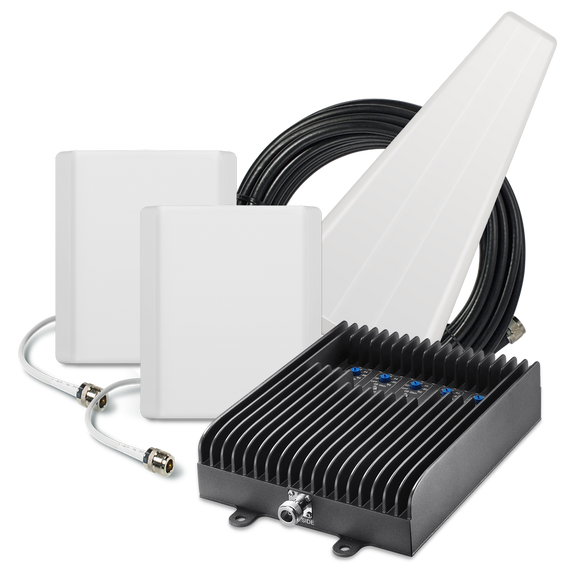
SureCall lists Force5 2.0 for medium commercial/multi-room coverage, Force8 for demanding commercial buildings, 5X MAX for larger problem areas and Fusion5X/Fusion products for smaller spaces. Selection requires measured band-specific signal, donor isolation, building layout and carrier requirements.
- Force5 2.0 medium commercial/multi-room systems
- Force8 higher-power enterprise applications
- 5X MAX and Fusion5X targeted commercial coverage
- C-Band/fiber DAS alternatives where traditional boosters do not fit
- Site survey, applicable codes and approved operating sequence
- Power, network/radio, standby and outage behavior
- Current product lifecycle, firmware and integration compatibility
- Training, documentation, inspection and preventive maintenance
Engineering and privacy
Boston High Tech confirms the current manufacturer model and site conditions before procurement. Relevant qualifications can be verified privately when appropriate; certificate copies, license numbers and named certificate-holder records are not published.
Request a site-specific design
Supported from our Charlotte headquarters and local client offices serving Massachusetts, New York and New Jersey. Arrange office visits in advance.
Official manufacturer references
How to compare and specify this product family
For SureCall Force5, Force8 and Commercial Signal Boosters, the right model and architecture depend on the site, existing infrastructure and operating policy. A proposal should clearly document the following signal-booster or distributed-antenna system decisions before equipment is ordered:
- Carrier and frequency-band requirements
- Outdoor donor-signal readings and building loss
- Donor/server antenna separation and isolation
- Coax routes, connector loss and grounding
- Coverage targets for each occupied area
- Monitoring, labeling and future carrier changes
Installation, testing and handoff
We begin with an RF survey rather than selecting an amplifier from square footage alone. The design documents measured signal, serving bands, antenna locations, cable loss, isolation and the coverage target for each priority area. Installation includes grounding and bonding review, labeled cable paths, commissioning measurements and a handoff record. Equipment must be used within current manufacturer and regulatory requirements; a booster cannot create usable service where adequate donor signal is unavailable.
Frequently asked questions
Questions about choosing among SureCall commercial booster families and what has to be measured on site before any model is ordered.
Which SureCall family suits a medium office versus a demanding building?
SureCall lists Force5 2.0 for medium commercial and multi-room coverage and Force8 for demanding commercial buildings, with 5X MAX for larger problem areas and Fusion5X or Fusion products for smaller spaces. Those descriptions narrow the shortlist. The model itself is not chosen from building type alone, because the numbers taken on site decide it.
Can you spec a system from our floor plans?
No. Selection requires measured band-specific signal, donor isolation, building layout and carrier requirements, and only the layout comes from a drawing. Someone has to be on site taking outdoor donor-signal readings and checking building loss in the areas that fail today. The floor plan stays useful for antenna placement and coax routing once those readings exist.
Where do the antennas go, and how far apart?
The donor antenna goes outside where the usable signal is, and the server antennas go in the areas that need coverage. Spacing between them is set by donor/server antenna separation and isolation, which is engineered rather than estimated. Coax routes, connector loss and grounding are laid out with it, since every connector and every extra foot of coax shows up in the result.
Which carriers do you need to know about before designing?
Every carrier that has to work in the building, named up front. Carrier and frequency-band requirements are a design input, and outdoor donor-signal readings and building loss are recorded per band, because a building can be fine on one band and unusable on another. Site survey, applicable codes and the approved operating sequence are documented with those readings.
What if the outdoor signal is too weak to boost?
Then a booster is the wrong tool for that building. C-Band/fiber DAS alternatives where traditional boosters do not fit are listed for exactly that situation, and the call comes from outdoor donor-signal readings and building loss rather than from preference. Settling it early avoids buying amplification for a donor signal that was never usable.
Part of the building already has in-building coverage equipment. How does a booster sit alongside it?
It gets planned as one system, since the proposal documents signal-booster or distributed-antenna system decisions together rather than as separate projects. Existing in-building equipment, its antennas and the carriers it serves are recorded during the survey, and current product lifecycle, firmware and integration compatibility are validated before anything is added to a building that already has coverage hardware.
Official SureCall software, firmware and support
Official manufacturer resources. We link out rather than host firmware.
Before updating: confirm model, hardware revision, current version, entitlement and rollback plan, and schedule monitored or life-safety-adjacent systems with the administrator.