
Credential technologies for smartphone, wallet, smart card, fob and legacy badge migrations.
Product and design guidance
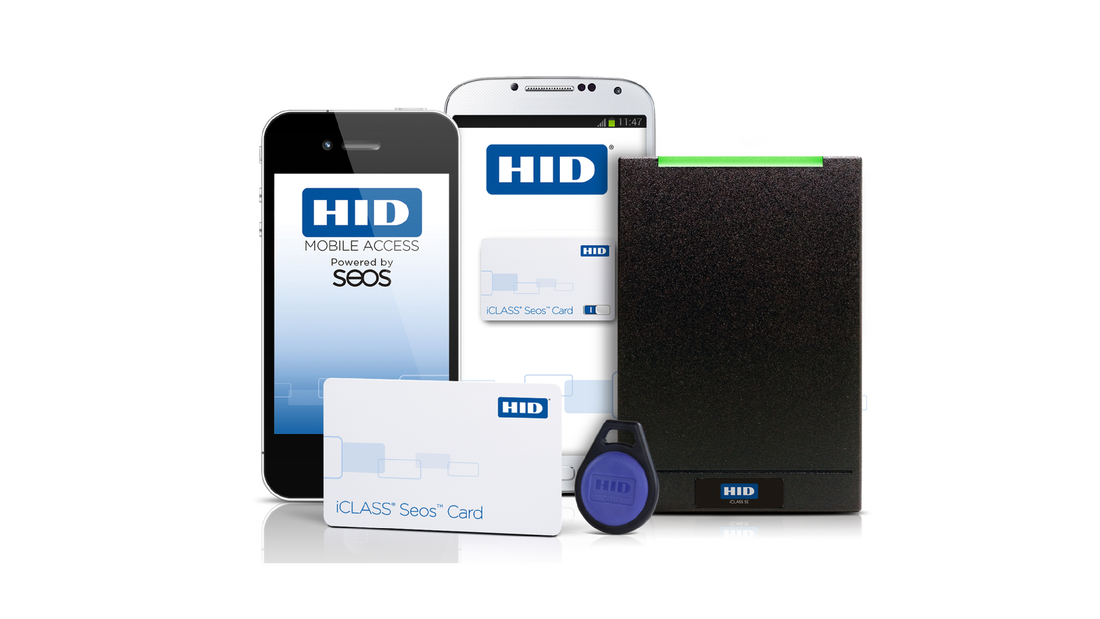
HID Mobile Access works with mobile-ready readers including Signo and applicable iCLASS SE devices. Seos, MIFARE DESFire, iCLASS and legacy proximity options have different security properties. A migration plan should address keys, encoding, issuance, revocation, Apple/Android device support, visitor credentials and non-phone fallback.
- HID Mobile Access and supported phone/watch workflows
- Seos and encrypted smart credentials
- MIFARE DESFire/iCLASS interoperability as designed
- Controlled retirement of clone-prone 125 kHz proximity badges
- Code-compliant lock, egress and fire-alarm sequence
- Network, power, battery and outage behavior
- Licenses, subscriptions, integrations and data ownership
- Administrator training, documentation and maintenance
How Boston High Tech helps
We survey the doors, existing panels and readers, credentials, network, identity workflow and integrations before finalizing a bill of materials. We may confirm relevant certification privately, but do not publish certificate copies, license numbers or named certificate-holder information.
Request a product-specific consultation
Serving projects from our Charlotte headquarters and local client offices in Massachusetts, New York and New Jersey. Please arrange office visits in advance.
Official manufacturer references
How to compare and specify this product family
For HID Mobile Access, Seos and Credentials, the right model and architecture depend on the site, existing infrastructure and operating policy. A proposal should clearly document the following access-control system decisions before equipment is ordered:
- Number and type of controlled openings
- Controller, reader, lock and credential compatibility
- Cloud or on-premise administration and ownership
- Offline behavior, backup power and emergency operation
- Directory, HR, video, visitor and elevator integrations
- Licensing, cybersecurity, training and lifecycle support
Installation, testing and handoff
A site survey records each opening, door hardware, cable path, power, network, credential policy and integration requirement. The design then maps readers, controllers, locks, inputs, outputs and administrator roles to the operational workflow. Commissioning includes door-by-door functional tests, failure-mode and backup-power checks, permission and schedule tests, event verification, administrator training and as-built documentation. Product availability, subscriptions and supported integrations are confirmed for the current project before procurement.
Frequently asked questions
Reader compatibility, credential technology and migration questions that come up when a site moves toward HID Mobile Access.
Which readers work with HID Mobile Access?
Mobile-ready readers, including Signo and applicable iCLASS SE devices. Check that against your existing reader population first, because a door with a reader that is not mobile-ready still needs a card or fob until the reader is changed. The survey covers doors, existing panels and readers before any bill of materials is finalized.
Not everyone here carries a smartphone. What do they use?
Cards and fobs stay in the plan: non-phone fallback and visitor credentials are written into the migration alongside Apple and Android device support. Decide who gets a phone credential, who keeps a physical credential, and how a contractor or visitor is issued one for a day, because issuance and revocation rules differ between those groups.
Do we have to swap every badge and reader at once?
No. The plan calls for controlled retirement of clone-prone 125 kHz proximity badges, which means readers and credentials change in a sequence you can staff and support. Order matters: keys and encoding are settled first, then reader changes at the doors that need them, then reissue by group so the help desk is not swamped in one week.
If a door loses power or the network, does the credential type matter?
No, egress does not depend on the credential. The code-compliant lock, egress and fire-alarm sequence is designed at the opening and holds whether the badge is Seos, DESFire or a phone. What does need writing down is the network, power, battery and outage behavior for each door, including whether it holds secure or releases and how long standby power must last.
Can DESFire and iCLASS cards keep working alongside Seos?
Interoperability is designed rather than assumed: MIFARE DESFire, iCLASS and Seos have different security properties, and the keys and encoding decide what a given reader accepts. List every credential format in circulation, including badges issued by a landlord or a sister site, so reader configuration is planned around the whole population instead of the newest cards.
Our IT group is asking about key management. What should the proposal say?
It should name who holds the keys used for encoding, and record licenses, subscriptions, integrations and data ownership beside that name. Add who issues and revokes credentials, which administrator accounts belong to your staff rather than to a service account, and where the encoding configuration is documented. Administrator training and maintenance are then scheduled against real people.
Official HID software, firmware and support
Official manufacturer resources. We link out rather than host firmware.
Before updating: confirm model, hardware revision, current version, entitlement and rollback plan, and schedule monitored or life-safety-adjacent systems with the administrator.