
Controller and management infrastructure for secure reader communications, firmware and open access-control architectures.
Product and design guidance
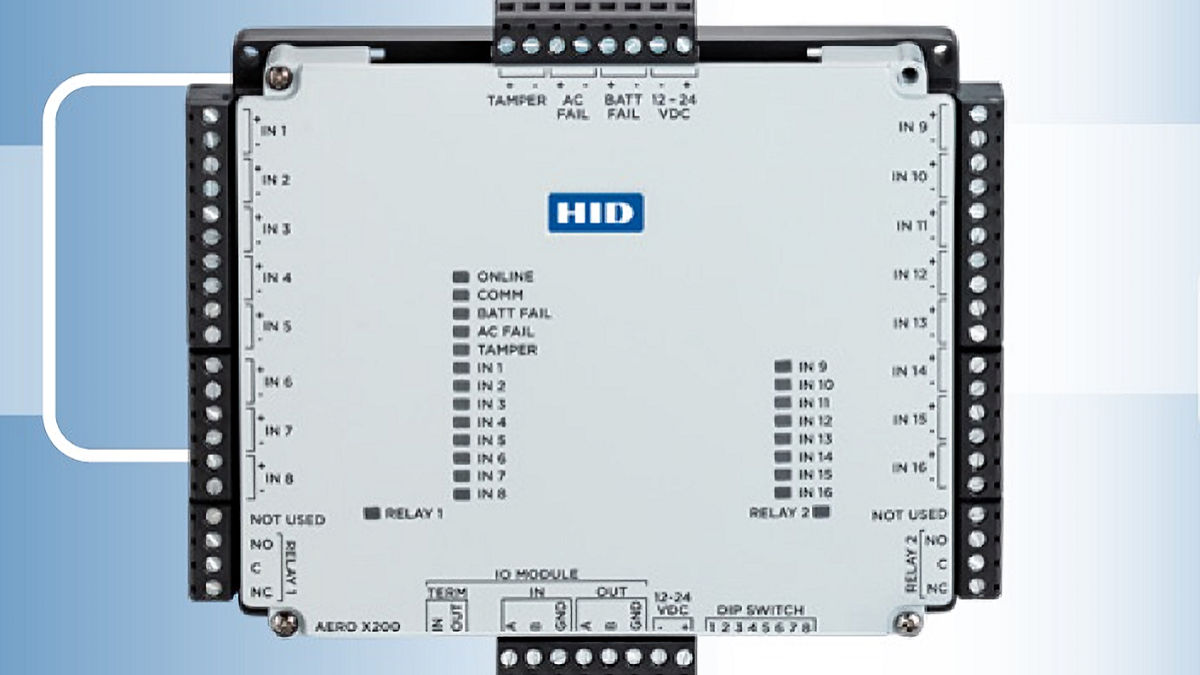
HID’s physical-access portfolio includes controller technologies and management tools such as HID Linq and HID Reader Manager. The access-control head-end, controller family, downstream modules, OSDP topology, certificates/keys and update process must be chosen as one architecture. HID readers are also widely used with supported third-party access platforms.
- Controller/head-end compatibility and expansion
- OSDP addressing, supervision and secure channel
- HID Linq/Reader Manager firmware and configuration ownership
- Credential key management, backups and technician access
- Code-compliant lock, egress and fire-alarm sequence
- Network, power, battery and outage behavior
- Licenses, subscriptions, integrations and data ownership
- Administrator training, documentation and maintenance
How Boston High Tech helps
We survey the doors, existing panels and readers, credentials, network, identity workflow and integrations before finalizing a bill of materials. We may confirm relevant certification privately, but do not publish certificate copies, license numbers or named certificate-holder information.
Request a product-specific consultation
Serving projects from our Charlotte headquarters and local client offices in Massachusetts, New York and New Jersey. Please arrange office visits in advance.
Official manufacturer references
How to compare and specify this product family
For HID Controllers, Linq and Reader Management, the right model and architecture depend on the site, existing infrastructure and operating policy. A proposal should clearly document the following access-control system decisions before equipment is ordered:
- Number and type of controlled openings
- Controller, reader, lock and credential compatibility
- Cloud or on-premise administration and ownership
- Offline behavior, backup power and emergency operation
- Directory, HR, video, visitor and elevator integrations
- Licensing, cybersecurity, training and lifecycle support
Installation, testing and handoff
A site survey records each opening, door hardware, cable path, power, network, credential policy and integration requirement. The design then maps readers, controllers, locks, inputs, outputs and administrator roles to the operational workflow. Commissioning includes door-by-door functional tests, failure-mode and backup-power checks, permission and schedule tests, event verification, administrator training and as-built documentation. Product availability, subscriptions and supported integrations are confirmed for the current project before procurement.
Frequently asked questions
Questions about matching HID controllers, reader management tools and OSDP topology to an existing access-control head-end.
Our head-end is already installed. Will HID controllers work with it?
Only if controller/head-end compatibility and expansion checks out, and the head-end version and controller family already in place decide that, not the new panel alone. The existing panels, readers, credentials and integrations are inventoried first, and expansion headroom is checked at the same time so a later door addition does not force a second head-end change.
Is it fine to pick controllers first and settle firmware and keys later?
No. The access-control head-end, controller family, downstream modules, OSDP topology, certificates and keys and the update process are chosen as one architecture, because moving any one of them moves the others. HID Linq and HID Reader Manager sit inside that same decision, since firmware and configuration ownership has to be settled while the design is still on paper.
Do readers home run to the panel, or can a run be daisy-chained?
That follows the OSDP topology chosen for the site, which is decided together with addressing and supervision rather than improvised at rough-in. The topology sets how many readers share a run, what address each one carries and how a fault is supervised. Draw it before cable is pulled, because changing it afterward means re-pulling, not re-programming.
What has to be settled about egress and the fire alarm before wiring starts?
The code-compliant lock, egress and fire-alarm sequence for each opening, written down and approved before controller outputs are landed. That sequence decides which relay drives what, and it is the item the authority having jurisdiction reviews. Network, power, battery and outage behavior are recorded next to it, since a door’s release path has to hold up when power is lost.
Can HID readers run on an access platform that is not HID?
Yes. HID readers are also used with supported third-party access platforms, so the reader decision and the head-end decision are not one decision. What has to be confirmed is that the specific platform supports the reader model, the credential technology and the OSDP addressing and supervision you plan to use, checked against that platform vendor’s current documentation.
Who holds the credential keys after the system is turned over?
Whoever the customer designates, and that is settled before readers are configured rather than after. Credential key management, backups and technician access are treated as one decision here, alongside licenses, subscriptions, integrations and data ownership. A customer holding its own keys needs a documented backup and a documented way to grant a technician temporary access.
Official HID software, firmware and support
Official manufacturer resources. We link out rather than host firmware.
Before updating: confirm model, hardware revision, current version, entitlement and rollback plan, and schedule monitored or life-safety-adjacent systems with the administrator.