
Battery electronic locks for PIN, proximity and specialty door applications without a networked panel at every opening.
Products and selection guidance
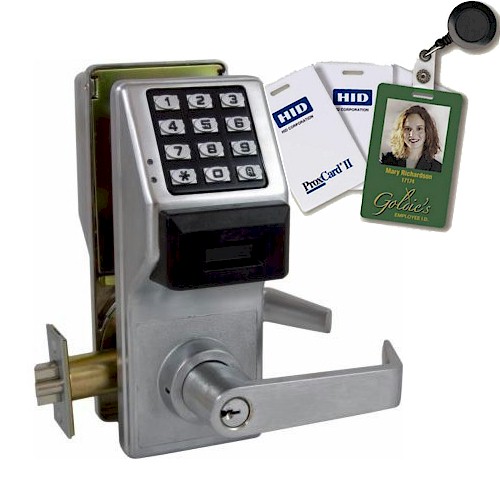
Trilogy standalone families cover cylindrical, mortise, narrow-stile, double-sided and exit-trim needs with keypad-only or credential/keypad variants. Select by exact door preparation, user/audit capacity, credential technology, weather, handing, exit device and desired local programming.
- DL keypad-only and PDL proximity/keypad model families
- Cylindrical, mortise, narrow-stile and exit-trim applications
- Double-sided, privacy and specialty functions
- DL-Windows database, audit and local programming workflow
- Door, lock, free-egress, accessibility and fire-alarm requirements
- Network, power, standby battery and outage behavior
- Current licenses, subscriptions, firmware and integrations
- Administrator training, backup, documentation and maintenance
Site-specific design
Boston High Tech inventories existing equipment and validates current manufacturer compatibility before specifying reuse, migration or replacement. Qualifications may be confirmed privately when needed; license numbers, certificate copies and named certificate-holder details are not published.
Request a manufacturer-specific consultation
Projects are supported from our Charlotte headquarters and local client offices serving Massachusetts, New York and New Jersey.
Official manufacturer references
How to compare and specify this product family
For Alarm Lock Trilogy Standalone Keypad and Prox Locks, the right model and architecture depend on the site, existing infrastructure and operating policy. A proposal should clearly document the following intrusion and alarm system decisions before equipment is ordered:
- Protected areas and zone strategy
- Detector technology and environmental conditions
- Keypads, user partitions and authority levels
- Communications path and monitoring compatibility
- Standby power and supervised circuits
- False-alarm reduction, testing and response procedures
Installation, testing and handoff
The site survey maps perimeter, interior and special-risk areas and accounts for pets, airflow, temperature, glass type, ceiling height and normal occupant movement. The scope defines zones, partitions, notification, communicator, monitoring handoff and backup-power assumptions. Commissioning includes walk tests, tamper and trouble tests, communications verification, user-code administration, training and a written zone list. Monitoring and permit requirements are confirmed for the project jurisdiction before activation.
Frequently asked questions
Questions about Trilogy standalone locks: which family fits an opening, and how doors are programmed without a panel.
How do DL models differ from PDL models?
By credential. DL keypad-only and PDL proximity/keypad model families split on whether the lock reads a card or fob in addition to a PIN. A PIN-only opening keeps the hardware simpler, while a proximity opening lets people carry a credential they already use elsewhere if the technology matches. Both are still chosen by door preparation and handing.
Which Trilogy fits a door that already has an exit device?
An exit-trim model. Cylindrical, mortise, narrow-stile and exit-trim applications are separate model paths, and the exit device on the door determines what trim can mount to it. Narrow-stile aluminum storefront doors are their own case again. The device manufacturer and function get identified from the actual door before any model goes into a quote.
Do we have to run cable or a network drop to each door?
No. These are battery electronic locks for sites that do not want a networked panel at every opening, so each lock carries its own power and there is no home run to a controller. What each door does need is correct preparation: handing, backset and existing prep verified, plus a plan for battery replacement at awkward heights and locations.
What do you need to know about the door before ordering?
Exact door preparation first: door type, handing, backset, existing bore or mortise pocket, frame condition, and whether the opening sees weather. Function matters just as much, since double-sided, privacy and specialty functions change the hardware rather than only the programming. A lock ordered against a guess about prep becomes a return and a schedule slip.
How do codes get loaded and audit trails pulled with no network?
Through the DL-Windows database, audit and local programming workflow, which holds the user information and audit records for the site. Two things get decided with it: who runs that workstation and keeps its database backed up, and how data moves between it and each lock on the models chosen, which is confirmed against current manufacturer documentation.
Can these locks share badges with our access-control system?
Only where the credential technology matches on both sides, so the badge is the first item to check, not the lock. A PDL proximity/keypad model reads what its reader supports, and if the site’s access panel uses a different technology, staff carry two credentials or the credential program changes. Lock events are retrieved locally rather than appearing in the panel event log.
Official Alarm Lock Trilogy software, firmware and support
Official manufacturer resources. We link out rather than host firmware.
Before updating: confirm model, hardware revision, current version, entitlement and rollback plan, and schedule monitored or life-safety-adjacent systems with the administrator.