
Electric locking, readers, credentials, switches and power products that complete access-controlled openings.
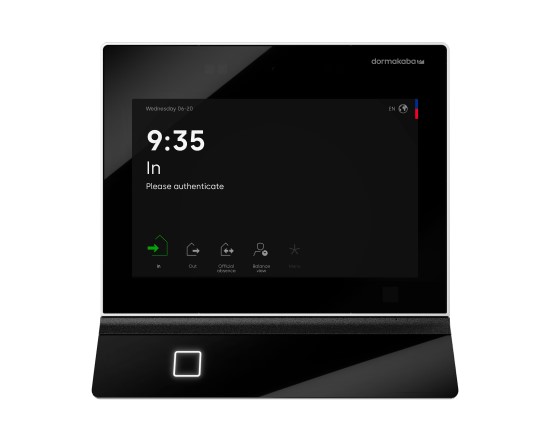
What this product family does
dormakaba’s Electronic Access & Data portfolio includes RCI electromagnetic locks, electric strikes, specialty locks and power supplies; standard-, high- and ultra-high-frequency readers/credentials; keypads; mobile credentials; switches; and RF receivers/transmitters. These components must be engineered as an opening, not purchased as unrelated parts.
Products and decisions
| Product area | What it includes | Selection guidance |
|---|---|---|
| Electric locking | RCI strikes, maglocks and specialty locks | Choose by frame/door prep, fail-safe/fail-secure, listing, preload and egress |
| Readers/credentials | 125 kHz, 13.56 MHz, UHF and mobile choices | Select security level, range, protocol and migration path |
| Request-to-exit/switches | Buttons, touchless devices, plates and specialty controls | Coordinate accessibility, signage and code-required release |
| Power | Listed regulated supplies and distribution | Calculate lock inrush/holding load, controller load and standby battery |
Questions to answer before quoting
- Lock and frame condition
- Fire alarm and egress sequence
- Credential security and read range
- Power, battery, surge and monitoring requirements
- Who owns administration, backups, updates and recurring services?
- What must continue working during network, internet or power failure?
- Which opening, egress, accessibility and life-safety requirements apply?
- What training, documentation and preventive maintenance are required?
Request a product-specific site survey
Boston High Tech serves projects from our Charlotte headquarters and local client offices serving Massachusetts, New York and New Jersey.
Official manufacturer references
Capabilities and product families were checked against the manufacturer links below.
How to compare and specify this product family
For dormakaba RCI Locks, Readers, Credentials and Power, the right model and architecture depend on the site, existing infrastructure and operating policy. A proposal should clearly document the following electronic lock and door-hardware system decisions before equipment is ordered:
- Opening type, handing, frame and door condition
- Fire rating, egress, accessibility and code constraints
- Fail-safe or fail-secure operation and emergency release
- Credential, reader and controller compatibility
- Battery, wireless gateway and offline behavior
- Mechanical key override, maintenance and lifecycle support
Installation, testing and handoff
Each opening is surveyed as a complete assembly. We verify the door, frame, handing, existing prep, latching, closer, egress hardware, power path and the required emergency behavior before specifying a lock. Installation includes alignment and mechanical correction within scope, cable and power testing, credential enrollment, door-state and request-to-exit tests, and failure-mode verification. The owner receives opening schedules, administrator guidance and maintenance requirements; private credential data and certificate details are not published.
Frequently asked questions
What buyers ask when specifying RCI locks, readers, credentials and power supplies as one engineered opening rather than separate parts.
Why can we not just order the strike, the reader and the power supply separately?
Because each choice constrains the next. The portfolio spans RCI electromagnetic locks, electric strikes, specialty locks and power supplies alongside readers, credentials, keypads, switches and RF receivers and transmitters: the lock sets the power draw, the credential sets the reader, and the reader sets the wiring back to the controller. Parts bought independently arrive matched to nothing in particular.
Which reader frequency should a new system use?
The credential decides, not the reader. The portfolio covers standard-, high- and ultra-high-frequency readers/credentials plus keypads and mobile credentials, so the real question is what people carry today, what security level the site wants next, and what read range the opening needs. Choose the credential and the migration path first, then the reader that matches that credential.
How do we size the power supply for a set of doors?
By calculation rather than estimate. Add the lock inrush/holding load, controller load and standby battery for every device fed by that supply, then select listed regulated supplies and distribution to carry the total. Running the numbers per supply also catches the case where one power source feeds devices that are supposed to behave differently during an alarm.
Does request-to-exit have to be a push button?
No. Request-to-exit devices include buttons, touchless devices, plates and specialty controls, and the right choice depends on the opening: mounting height and reach for accessibility, whether staff pass through with their hands full, and what signage the release requires. Whichever device is selected, the release is tested under normal use and again with the alarm sequence active.
Will these readers work with the access panel already installed?
Only where the reader output and the panel input agree, so credential, reader and controller compatibility is verified before anything is ordered. Record what the existing panel accepts, how each reader is wired back to it, and whether the credential you intend to issue is readable at both ends. Where the site record cannot settle a question, current dormakaba documentation governs the selection.
What do these openings do when the fire alarm activates?
Whatever the approved fire alarm and egress sequence for that building says, which the owner and the authority having jurisdiction agree on before hardware is selected. Each opening is then specified fail-safe or fail-secure to match the sequence, and the wiring is proven against a live alarm signal at commissioning instead of being inferred from the lock model.
dormakaba owner, administrator and buyer resources
Discuss dormakaba installation, maintenance or service
Detailed guides are maintained by 360TechnologyGroup.com, the parent-company knowledge center.
Official dormakaba software, firmware and support
Official manufacturer resources. We link out rather than host firmware.
Before updating: confirm model, hardware revision, current version, entitlement and rollback plan, and schedule monitored or life-safety-adjacent systems with the administrator.