
Electrified locking products for mortise, cylindrical, rim-exit, gate, cabinet and delayed-egress applications.
Products and selection guidance
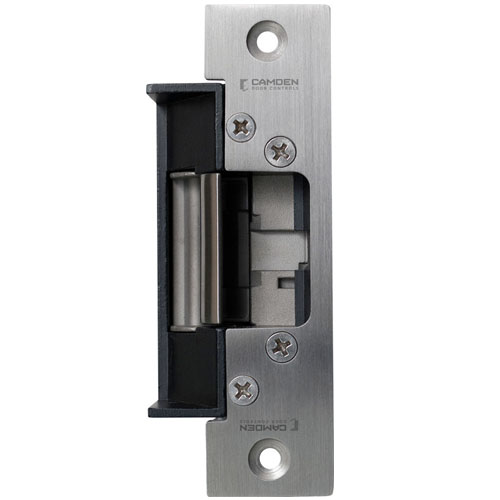
Camden offers fire/security-listed strike families, preload rim strikes, single/double maglocks, delayed-egress locks and specialty locks. Selection requires exact lockset/exit-device compatibility, frame material, latch geometry, preload, fail-safe/fail-secure, fire label, egress and power calculations.
- Electric strikes for cylindrical, mortise and rim exit hardware
- Preload, fire-rated and outdoor strike choices
- Single/double and delayed-egress magnetic locks
- Cabinet, gate and specialty electrified locks
- Door, lock, free-egress, accessibility and fire-alarm requirements
- Network, power, standby battery and outage behavior
- Current licenses, subscriptions, firmware and integrations
- Administrator training, backup, documentation and maintenance
Site-specific design
Boston High Tech inventories existing equipment and validates current manufacturer compatibility before specifying reuse, migration or replacement. Qualifications may be confirmed privately when needed; license numbers, certificate copies and named certificate-holder details are not published.
Request a manufacturer-specific consultation
Projects are supported from our Charlotte headquarters and local client offices serving Massachusetts, New York and New Jersey.
Official manufacturer references
How to compare and specify this product family
For Camden Electric Strikes, Maglocks and Specialty Locks, the right model and architecture depend on the site, existing infrastructure and operating policy. A proposal should clearly document the following electronic lock and door-hardware system decisions before equipment is ordered:
- Opening type, handing, frame and door condition
- Fire rating, egress, accessibility and code constraints
- Fail-safe or fail-secure operation and emergency release
- Credential, reader and controller compatibility
- Battery, wireless gateway and offline behavior
- Mechanical key override, maintenance and lifecycle support
Installation, testing and handoff
Each opening is surveyed as a complete assembly. We verify the door, frame, handing, existing prep, latching, closer, egress hardware, power path and the required emergency behavior before specifying a lock. Installation includes alignment and mechanical correction within scope, cable and power testing, credential enrollment, door-state and request-to-exit tests, and failure-mode verification. The owner receives opening schedules, administrator guidance and maintenance requirements; private credential data and certificate details are not published.
Frequently asked questions
Questions that come up when matching Camden strikes, maglocks and delayed-egress locks to the exit devices already on your doors.
What is preload, and why does it change the strike we buy?
Preload is the side pressure a door puts on its latch when weatherstripping, a closer or building stack effect holds the door tight against the frame, and a strike that will not release under that pressure produces service calls. Camden lists preload rim strikes among its strike families for rim exit hardware, and whether an opening needs one is judged at the door with the exit device in place.
Should this door get a maglock or an electric strike?
The door and its exit hardware decide. An electric strike releases the latch already in the door, so exact lockset and exit-device compatibility, frame material and latch geometry have to line up; single/double maglocks hold the door face instead and bring their own egress release requirements. Where there is no usable latch or frame prep, the strike option removes itself from the list.
Does a delayed-egress opening change what happens at install?
Yes. Delayed-egress locks are installed against an approved operating sequence, so the fire alarm release, the door signage and the release behavior are agreed with the authority having jurisdiction before the order goes in. Commissioning then demonstrates that sequence with a real alarm signal and a witness present, and the demonstration is recorded with the closeout documents.
Can these locks be used on an exterior gate?
Camden’s range includes cabinet, gate and specialty electrified locks, so the product side is covered; the exterior conditions are what need engineering. An outdoor opening brings frame material, alignment that shifts with temperature and settling, a water path to manage, and a longer cable run back to the power supply. Outdoor strike choices are called out separately from interior ones for that reason.
How do we keep a fire-rated opening intact when we electrify it?
By matching the door’s label to hardware suited for that use and by refusing field modifications that break the pairing. Camden offers fire/security-listed strike families, but whether a specific model suits your labeled opening is confirmed against current Camden documentation and with the authority having jurisdiction before installation. No hole is drilled in a labeled frame on the strength of a catalog page.
Will the lock we choose work with our access control panel?
Two things have to match: the panel output has to suit the lock’s voltage and current draw, and the lock’s fail-safe or fail-secure operation and emergency release have to match the sequence the building expects. Power is where mismatches surface, since a maglock and a strike load a supply differently. Record the relay type and the measured load on the opening schedule.
Camden Controls owner, administrator and buyer resources
Discuss Camden Controls installation, maintenance or service
Detailed guides are maintained by 360TechnologyGroup.com, the parent-company knowledge center.
Official Camden Door Controls software, firmware and support
Official manufacturer resources. We link out rather than host firmware.
Before updating: confirm model, hardware revision, current version, entitlement and rollback plan, and schedule monitored or life-safety-adjacent systems with the administrator.