
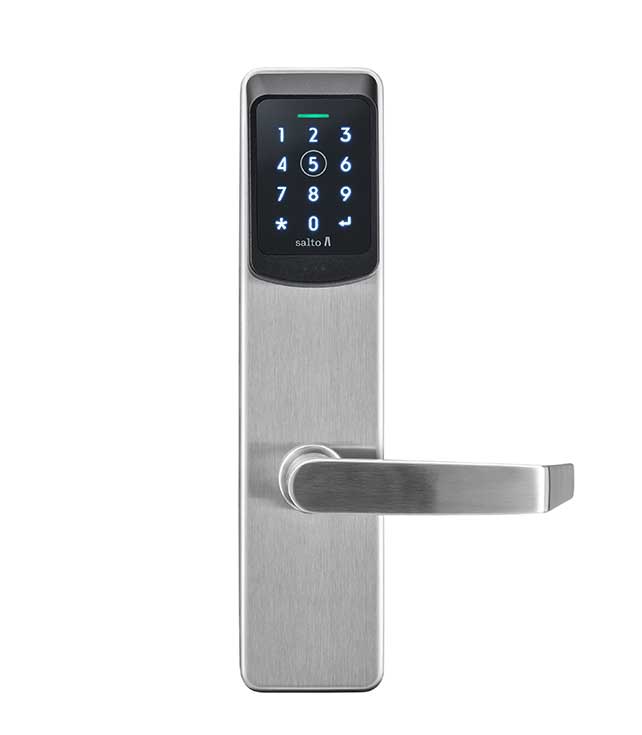
An on-premise SALTO platform combining SVN data-on-card and optional BLUEnet wireless connectivity across electronic locks, cylinders, readers and controllers.
What this product family does
SALTO Space is designed for sites that want local access-control management and broad electronic-lock coverage. SVN can distribute access information through credentials, while BLUEnet supports more connected real-time workflows on applicable devices. The design may combine offline, virtually networked, wireless online and hardwired access points.
Products and decisions
| Product area | What it includes | Selection guidance |
|---|---|---|
| Management | On-premise SALTO Space software and database | Assign server, backup, update and administrator ownership |
| SVN | Data-on-card virtual network | Plan update points, credential circulation and lost-card response |
| BLUEnet | Wireless online connectivity for supported locks/controllers | Survey gateway/node locations, RF coverage and real-time requirements |
| Hardware | XS4 locks, cylinders, wall readers and controllers | Match every opening to door prep, traffic, fire rating and online/offline need |
Questions to answer before quoting
- On-premise server and backup policy
- Which doors require real-time online status?
- Credential technology and update-point strategy
- Integration and mobile-key requirements
- Who owns administration, backups, updates and recurring services?
- What must continue working during network, internet or power failure?
- Which opening, egress, accessibility and life-safety requirements apply?
- What training, documentation and preventive maintenance are required?
Request a product-specific site survey
Boston High Tech serves projects from our Charlotte headquarters and local client offices serving Massachusetts, New York and New Jersey.
Official manufacturer references
Capabilities and product families were checked against the manufacturer links below.
How to compare and specify this product family
For SALTO Space On-Premise Smart Access, the right model and architecture depend on the site, existing infrastructure and operating policy. A proposal should clearly document the following access-control system decisions before equipment is ordered:
- Number and type of controlled openings
- Controller, reader, lock and credential compatibility
- Cloud or on-premise administration and ownership
- Offline behavior, backup power and emergency operation
- Directory, HR, video, visitor and elevator integrations
- Licensing, cybersecurity, training and lifecycle support
Installation, testing and handoff
A site survey records each opening, door hardware, cable path, power, network, credential policy and integration requirement. The design then maps readers, controllers, locks, inputs, outputs and administrator roles to the operational workflow. Commissioning includes door-by-door functional tests, failure-mode and backup-power checks, permission and schedule tests, event verification, administrator training and as-built documentation. Product availability, subscriptions and supported integrations are confirmed for the current project before procurement.
Frequently asked questions
What SVN, BLUEnet and XS4 hardware each contribute in an on-premise SALTO Space design, and who owns the server.
How does SVN differ from BLUEnet?
SVN is the data-on-card virtual network: access information travels with the credential, so the planning work is update points, credential circulation and lost-card response. BLUEnet is wireless online connectivity for supported locks and controllers, so the planning work moves to gateway and node locations, RF coverage and which doors genuinely need real-time behavior. One site can use both.
Which SALTO devices go on which openings?
XS4 locks and cylinders, wall readers and controllers make up the hardware side, and each opening is matched to one of them by door prep, traffic, fire rating and whether that door has to be online or can stay offline. Two doors on the same corridor can end up with different hardware for exactly those reasons.
Our staff rarely pass the main lobby. Does SVN still work?
It works when credentials pass an update point somewhere on the routes people actually walk, since access information moves through the credential itself. Place update points on those routes instead of at the front door by default, and plan credential circulation and lost-card response around the same map. Openings that cannot tolerate that delay are candidates for online connectivity.
What does BLUEnet need surveyed before you can quote it?
Gateway/node locations first, then RF coverage across the areas holding those openings, then the list of doors with real-time requirements. Power and mounting for each node are recorded on the same walk. Where coverage looks doubtful in a remote wing, that wing may be better served as an offline opening with an update point nearby.
Which doors should be real-time online instead of data-on-card?
The ones where you need live status or must cancel a credential without waiting for it to reach an update point: cash handling rooms, server rooms and shared exterior doors, for example. Those openings get BLUEnet coverage on supported locks and controllers, while the rest can stay on SVN, which keeps the gateway count and the RF survey smaller.
Do we need our own server, and who backs it up?
Yes: SALTO Space software and database run on-premise, so a server on your side holds them, and the backup belongs to whoever the proposal names. Assign server, backup, update and administrator ownership before installation, including whether IT or the security team holds the database copy and who applies updates. Training is scheduled for those same people.
SALTO owner, administrator and buyer resources
Discuss SALTO installation, maintenance or service
Detailed guides are maintained by 360TechnologyGroup.com, the parent-company knowledge center.
Official SALTO software, firmware and support
Official manufacturer resources. We link out rather than host firmware.
Before updating: confirm model, hardware revision, current version, entitlement and rollback plan, and schedule monitored or life-safety-adjacent systems with the administrator.