
Carrier-agnostic in-building cellular enhancement for small commercial spaces through large campuses.
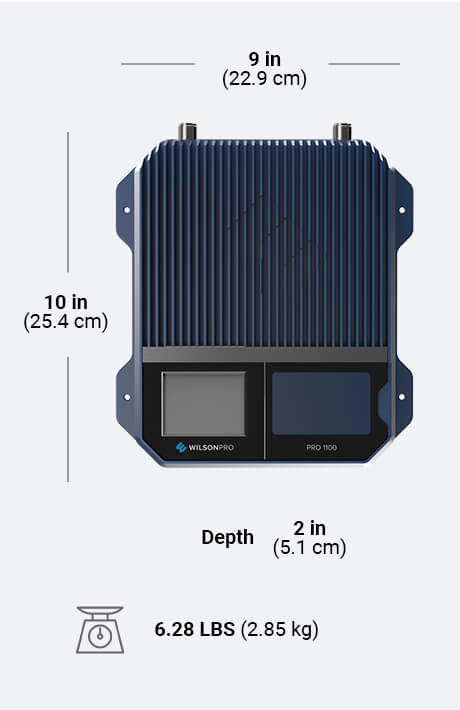
Product and design guidance
WilsonPro systems use donor antennas, amplifiers and distributed indoor antennas to improve usable carrier signal. Product choice is based on measured downlink/uplink, carriers/bands, building area/materials, donor isolation and user density—not advertised square footage alone. Large systems may use multi-tower targeting and scalable distribution.
- Small/medium commercial versus enterprise amplifier selection
- All-carrier band support and current 5G/4G spectrum
- Donor antenna, amplifier and indoor antenna topology
- Multi-tower targeting, remote monitoring and scalable coverage
- Site survey, applicable codes and approved operating sequence
- Power, network/radio, standby and outage behavior
- Current product lifecycle, firmware and integration compatibility
- Training, documentation, inspection and preventive maintenance
Engineering and privacy
Boston High Tech confirms the current manufacturer model and site conditions before procurement. Relevant qualifications can be verified privately when appropriate; certificate copies, license numbers and named certificate-holder records are not published.
Request a site-specific design
Supported from our Charlotte headquarters and local client offices serving Massachusetts, New York and New Jersey. Arrange office visits in advance.
Official manufacturer references
How to compare and specify this product family
For WilsonPro Commercial and Enterprise Cell Signal Boosters, the right model and architecture depend on the site, existing infrastructure and operating policy. A proposal should clearly document the following signal-booster or distributed-antenna system decisions before equipment is ordered:
- Carrier and frequency-band requirements
- Outdoor donor-signal readings and building loss
- Donor/server antenna separation and isolation
- Coax routes, connector loss and grounding
- Coverage targets for each occupied area
- Monitoring, labeling and future carrier changes
Installation, testing and handoff
We begin with an RF survey rather than selecting an amplifier from square footage alone. The design documents measured signal, serving bands, antenna locations, cable loss, isolation and the coverage target for each priority area. Installation includes grounding and bonding review, labeled cable paths, commissioning measurements and a handoff record. Equipment must be used within current manufacturer and regulatory requirements; a booster cannot create usable service where adequate donor signal is unavailable.
Frequently asked questions
Questions about designing a WilsonPro in-building cellular system from measured signal rather than a coverage claim.
Can you size a system from our square footage?
No. Product choice comes from measured downlink and uplink, the carriers and bands in use, building area and materials, donor isolation and user density, not advertised square footage alone. Two buildings with the same floor area can call for different amplifiers when one is concrete and glass and the other is wood frame, or when one sits farther from its donor tower.
Does one system serve every carrier our tenants use?
A WilsonPro system is carrier-agnostic, and all-carrier band support with current 5G/4G spectrum is confirmed for the model selected. Start by recording which carriers and frequency bands the people in the building actually use, because that list decides which bands the amplifier has to pass. Small or medium commercial and enterprise amplifier selection is weighed against the same list.
How far apart do the donor and indoor antennas have to be?
Far enough to hold isolation, and the required separation comes from the site rather than a fixed number. Donor/server antenna separation and isolation is calculated from the outdoor donor-signal readings and the gain the amplifier will run, and the roof layout decides whether that separation can be achieved. Where it cannot, the donor antenna moves or its aim changes.
Is existing coax in the building worth reusing?
Plan on designed runs rather than inherited ones. Coax routes, connector loss and grounding are part of the design, because every connector and every extra foot of cable comes off the signal budget the amplifier has to work with. Grounding is drawn where the cable enters the building, and the route is coordinated with the pathways already in place.
What approvals or documentation are needed before the amplifier is energized?
The design records the site survey, applicable codes and the approved operating sequence before anything is switched on, and which approvals apply depends on the building and on the carriers whose spectrum is being amplified. Training, documentation, inspection and preventive maintenance are handed over with the system, so the operating sequence stays available to whoever inspects it later.
Can a campus be covered by one system, and can we watch it remotely?
Large systems may use multi-tower targeting and scalable distribution, so a campus can be treated as one design instead of separate buildings. Remote monitoring is decided within that same scope, since equipment spread across several buildings is hard to check by walking it. Whether your site qualifies depends on the donor readings and the coverage area required.
Official WilsonPro software, firmware and support
Official manufacturer resources. We link out rather than host firmware.
Before updating: confirm model, hardware revision, current version, entitlement and rollback plan, and schedule monitored or life-safety-adjacent systems with the administrator.