
Door activation, request-to-exit, relay, power and accessibility-control products for complete openings.
Products and selection guidance
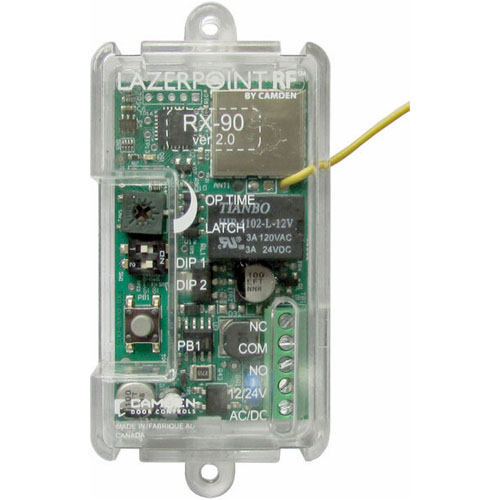
Camden’s activation/control portfolio includes push plates, touchless switches, key switches, REX detectors, wireless transmitters/receivers, relays/timers, power supplies and barrier-free restroom/emergency call kits. Specify the complete operating sequence, annunciation, accessibility and lock interface rather than treating the switch as an isolated device.
- Push plates, touchless sensors and key/reception switches
- Encrypted wireless transmitters, receivers, fobs and keypads
- Relays, timers, power supplies and annunciators
- Barrier-free restroom and emergency-call control kits
- Door, lock, free-egress, accessibility and fire-alarm requirements
- Network, power, standby battery and outage behavior
- Current licenses, subscriptions, firmware and integrations
- Administrator training, backup, documentation and maintenance
Site-specific design
Boston High Tech inventories existing equipment and validates current manufacturer compatibility before specifying reuse, migration or replacement. Qualifications may be confirmed privately when needed; license numbers, certificate copies and named certificate-holder details are not published.
Request a manufacturer-specific consultation
Projects are supported from our Charlotte headquarters and local client offices serving Massachusetts, New York and New Jersey.
Official manufacturer references
How to compare and specify this product family
For Camden Switches, Touchless Controls, Restroom and Wireless Systems, the right model and architecture depend on the site, existing infrastructure and operating policy. A proposal should clearly document the following access-control system decisions before equipment is ordered:
- Number and type of controlled openings
- Controller, reader, lock and credential compatibility
- Cloud or on-premise administration and ownership
- Offline behavior, backup power and emergency operation
- Directory, HR, video, visitor and elevator integrations
- Licensing, cybersecurity, training and lifecycle support
Installation, testing and handoff
A site survey records each opening, door hardware, cable path, power, network, credential policy and integration requirement. The design then maps readers, controllers, locks, inputs, outputs and administrator roles to the operational workflow. Commissioning includes door-by-door functional tests, failure-mode and backup-power checks, permission and schedule tests, event verification, administrator training and as-built documentation. Product availability, subscriptions and supported integrations are confirmed for the current project before procurement.
Frequently asked questions
Questions about specifying Camden activation, request-to-exit, wireless and restroom control products as part of a complete opening.
What is the difference between a push plate and a touchless switch?
A push plate is operated by contact and a touchless switch by a hand presented to the sensor, so the touchless version removes the physical push from the sequence. This page groups push plates, touchless sensors and key/reception switches together because the real decision is who may operate the door, from where, and how much traffic the actuator sees each day.
Can an actuator be added without pulling wire to it?
Yes, where encrypted wireless transmitters and receivers replace the wired run between the actuator and the control point. The receiver still needs a wired path to the relay and the lock interface, and the transmitter still needs power or a battery service plan. Mounting height and clear approach are set by accessibility requirements whether the device is wired or wireless.
Which decisions come before ordering a barrier-free restroom kit?
The complete operating sequence for the room, written before parts are picked: what activates the door, what is annunciated, who receives the emergency call and how that call is cleared. This page groups barrier-free restroom and emergency-call control kits as a family and asks for annunciation, accessibility and the lock interface to be specified rather than the switch treated as an isolated device.
Where does a request-to-exit device fit in the sequence?
Between the person leaving and the access system: REX detectors signal an intended exit so the opening is not reported as a forced door, and they can sit in the release path for the lock. This page lists them with the relays and timers that carry that interface. Coordinate the sequence with the lock, the free-egress hardware and the fire alarm before wiring is roughed in.
How is fire alarm release handled at these openings?
At the lock interface and the power path rather than inside the actuator, and the arrangement is reviewed with the authority having jurisdiction. This page pairs its product families with door, lock, free-egress, accessibility and fire-alarm requirements for that reason. Mechanical free egress is verified at each opening whichever switch is installed, so a person can leave with the control powered down.
Do these devices need their own power supply?
That depends on the current the opening actually draws. An electrified lock, an operator, a receiver and an annunciator each add load, and this page lists relays, timers, power supplies and annunciators as products to specify rather than borrow. Total every device on the sequence, size the supply and standby capacity from that total, and label the circuit at the panel.
Camden Controls owner, administrator and buyer resources
Discuss Camden Controls installation, maintenance or service
Detailed guides are maintained by 360TechnologyGroup.com, the parent-company knowledge center.
Official Camden Door Controls software, firmware and support
Official manufacturer resources. We link out rather than host firmware.
Before updating: confirm model, hardware revision, current version, entitlement and rollback plan, and schedule monitored or life-safety-adjacent systems with the administrator.